Knowledge Drops
Oct 22, 2026
Healthcare AI Security: 6 Principles for Safe, Secure AI Agents

A practical framework for evaluating AI agents in high-stakes healthcare workflows
AI in healthcare is moving beyond tools that summarize, transcribe or assist. AI agents can now interpret information, navigate workflows, interact with systems and take action.
That creates a fundamentally different security challenge in healthcare.
If an AI agent can process a referral, register a patient or update information in a clinical system, healthcare leaders need to know exactly what it can access, what it can do, what it retains and how every action can be reviewed.
Traditional security controls still matter. Healthcare AI vendors should have strong safeguards around sensitive data, including encryption, tenant isolation, vulnerability management, incident response and measures designed to secure Protected Health Information (PHI).
But securing the underlying platform is only the starting point. AI agents also require controls around their access, authority and behavior.
Here are six principles healthcare organizations should consider when evaluating AI agents.
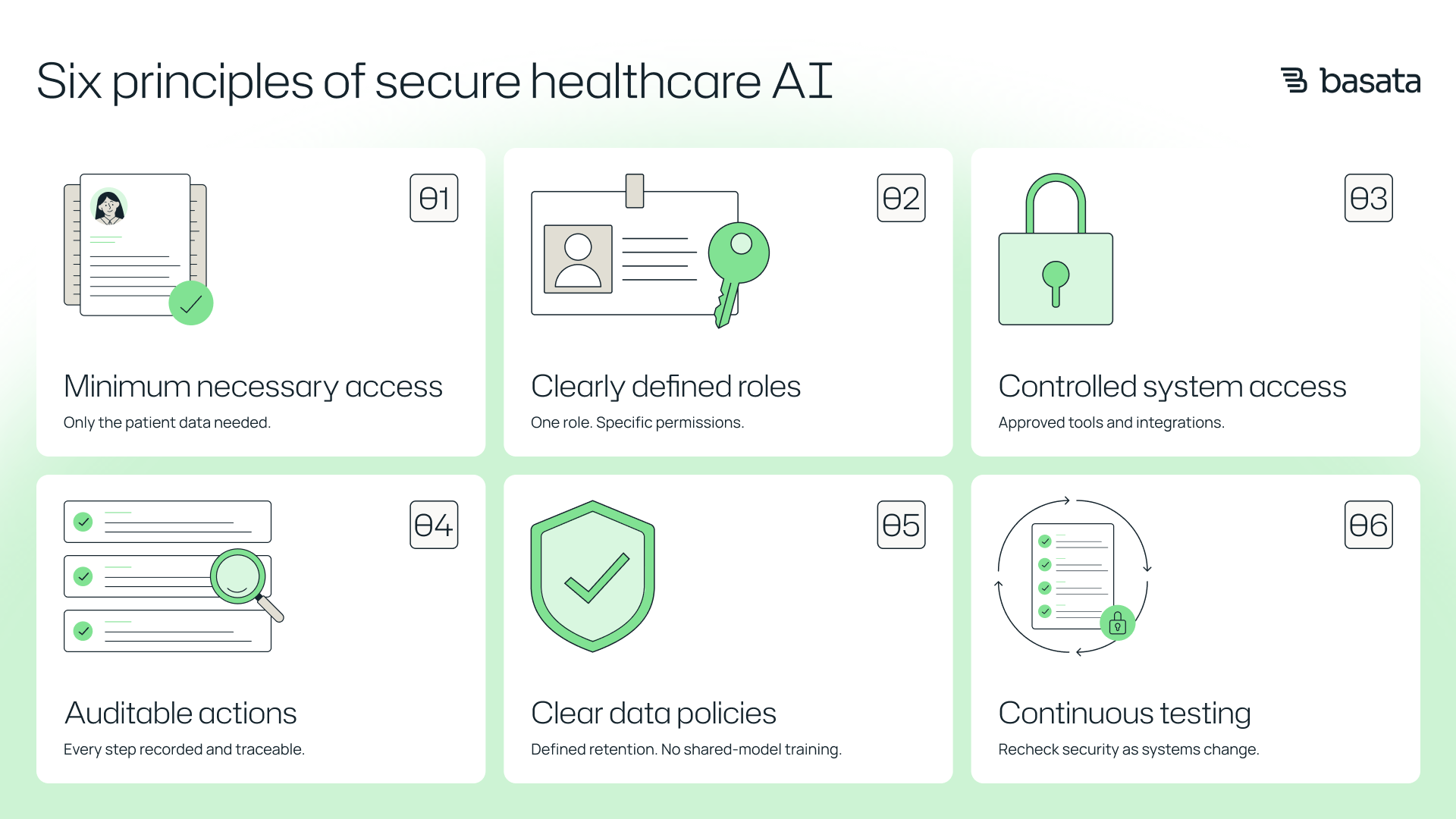
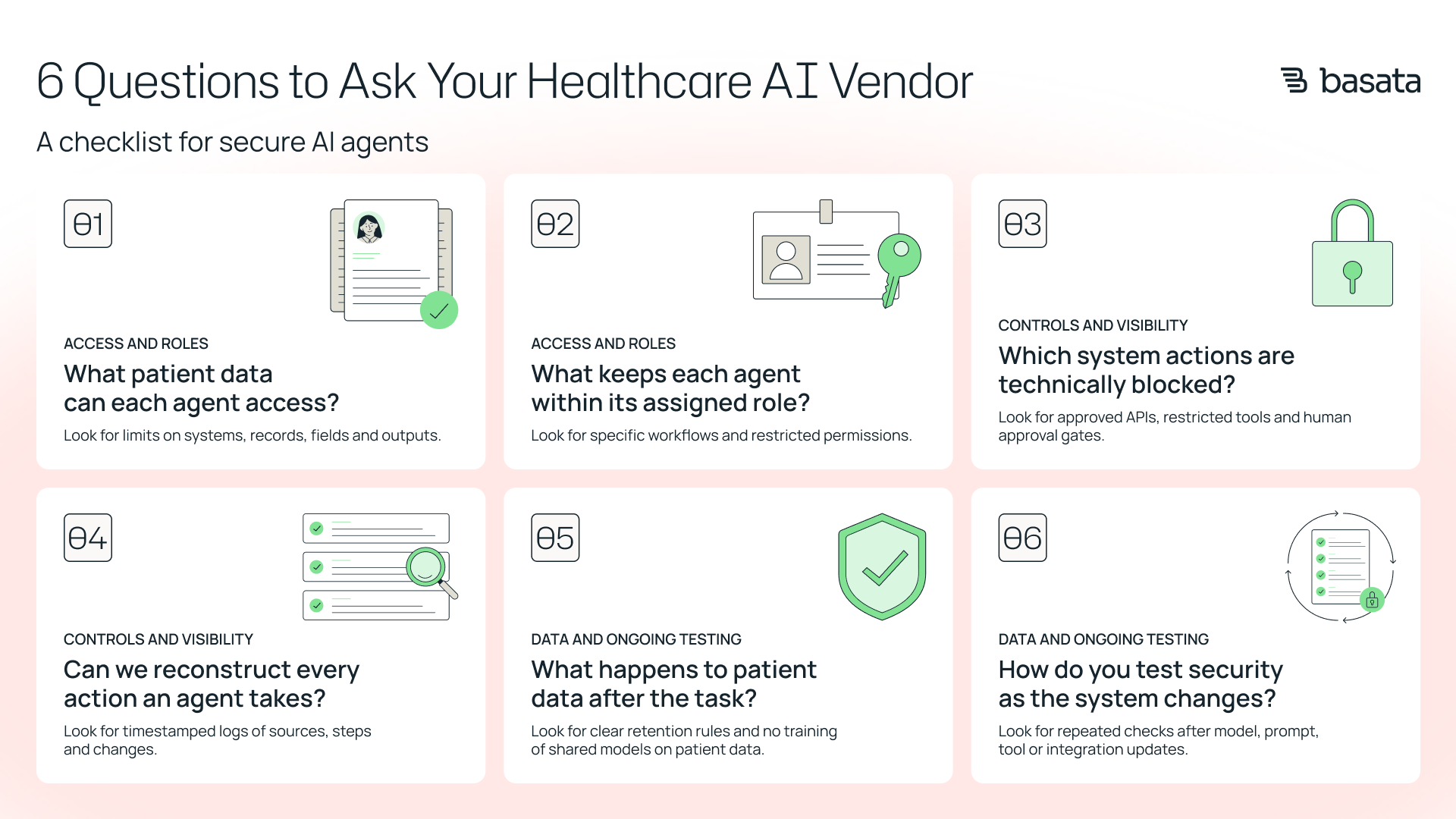
Principle #1: Limit AI agent access to the minimum necessary patient data
A healthcare AI agent should only be able to access the systems, records and individual data fields required for its specific task.
For example, an agent answering routine patient FAQs only needs practice-level details, including hours, locations, and prep instructions, and should have no access to patient charts or clinical histories.
The same principle applies to outputs. Agents should return only the information required for the healthcare workflow, rather than exposing unnecessary patient information.
Ask any of your partners managing your agents: Can you show us exactly which healthcare systems, records and fields each agent can access—and what data it is allowed to return?
Principle #2: Give every healthcare AI agent a specific role
Limiting what an agent can see isn't enough. Healthcare organizations also need to limit what it can do.
AI agents should be built around specific healthcare workflows and responsibilities, rather than deployed as generalists, and given only the tools, instructions, and permissions required to complete their assigned jobs.
A patient scheduling agent, for example, needs authorization to verify patient identity, check provider availability and make appointments. Giving that same agent unrestricted access across the EHR and document repository invites risk, making it possible for a single prompt or error to trigger actions outside the agent’s intended role.
At Southwest Cardiovascular Associates, Basata-enabled AI agents are constrained to specific workflows, such as referral intake and chart indexing, helping the organization automate document processing while supporting same-day patient referral turnaround..
Ask your healthcare AI vendor: What prevents an agent from taking actions outside the patient workflow it was designed to perform?
Principle #3: Secure AI Agent Access to EHRs and Clinical Systems
When a healthcare AI agent interacts with an EHR or another clinical system, access should happen through controlled integrations, approved tools and clearly defined APIs.
A secure approach combines AI's ability to interpret information and intent with deterministic rules and human oversight for executing sensitive workflows. This helps ensure that AI agents operate within defined boundaries while consequential decisions and approvals remain under human control.
Consider a patient referral workflow: an agent might be configured to extract demographic details, assign a specialty category, or create an intake chart. That same agent, however, should never possess the tooling to browse clinical histories, edit physician notes, or change active medications.
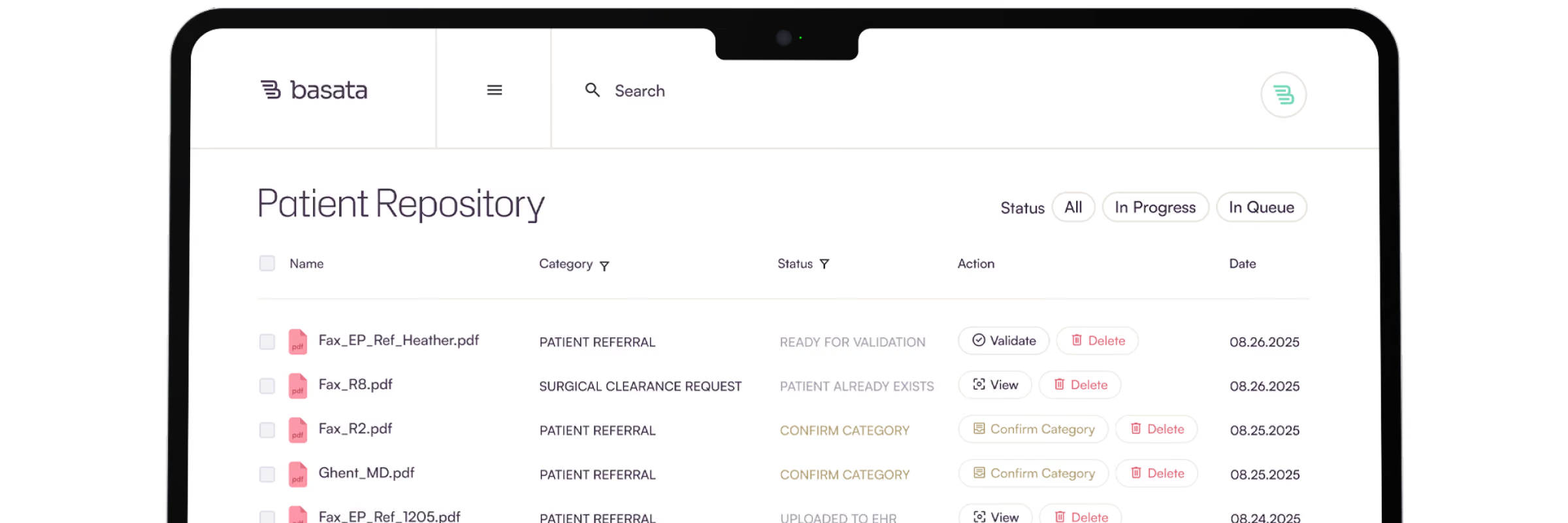
At Southwest Cardiovascular Associates, Basata’s integration with NextGen enables AI to create structured partial charts and stage documents in dedicated review queues. That way, the AI extracts and organizes incoming referral data, but still requires staff verification before patient scheduling.
The goal is to enforce security boundaries through technical controls, rather than relying on prompts alone to prevent unauthorized actions.
Ask your AI healthcare vendor: Which actions are technically unavailable to an agent, rather than simply prohibited by its instructions?
Principle #4: Make every AI agent action auditable
Healthcare teams should be able to reconstruct what an AI agent did just as they would review activity performed by a person.
That means every action should be timestamped and attributable, with a clear record of the source information the agent used, what it extracted, which workflow it followed and what it changed in downstream systems.
Auditability matters for more than compliance. It helps teams investigate edge cases, validate outcomes and quickly understand what happens when something doesn't look right.
At Tri-City Cardiology, Basata-enabled AI agents take patient calls, summarize conversations, and register new patients, then route their output for human approval. Every agent action is timestamped and listed in a centralized platform, helping staff reconstruct the full interaction and verify the record before scheduling the patient. This workflow helps Tri-City eliminate hours of manual administrative work and has contributed to a 30% increase in administrative productivity.
Ask your healthcare AI vendor: Can our team reconstruct every step an agent took and the information it used to make that decision?
Principle #5: Protect Patient Data Through Clear Retention and AI Model Training Policies
Healthcare AI systems must operate under a Business Associate Agreement (BAA), providing clear terms and technical controls governing patient data storage, retention, and secondary use.
AI agents frequently need temporary context to complete a task. That does not mean that information should live indefinitely inside an AI system.
Healthcare organizations should understand how vendors store, retain and use PHI, including what happens to an agent's working context after a task is complete.
Where information needs to persist, such as an indexed referral or call summary, it should be stored in the appropriate healthcare system according to the organization's retention requirements.
Healthcare organizations should also require clear commitments around model training. Patient data used to complete a healthcare workflow should not become training data for shared or third-party AI models.
Ask your healthcare AI vendor: What happens to patient information after an agent completes its task, and is any customer data used to train AI models?
Principle #6: Test AI agents continuously for security and compliance, not just before launch
A healthcare AI agent that behaved correctly six months ago should not simply be assumed to behave the same way today.
Models change. Prompts change. Integrations change. Tools and workflows change.
Healthcare AI systems should therefore be evaluated regularly to confirm that agents continue to follow their instructions, respect permissions and remain within their intended roles.
Testing should include challenging scenarios designed to uncover unexpected behavior—for example, attempts to persuade an agent to access an unrelated patient chart, bypass a permission or write information somewhere it is not authorized to write.
This is especially important as AI systems become more capable. Security isn't a one-time certification. It is an ongoing discipline.
Ask your healthcare AI vendor: How do you test agent behavior after changes to models, prompts, tools or integrations?
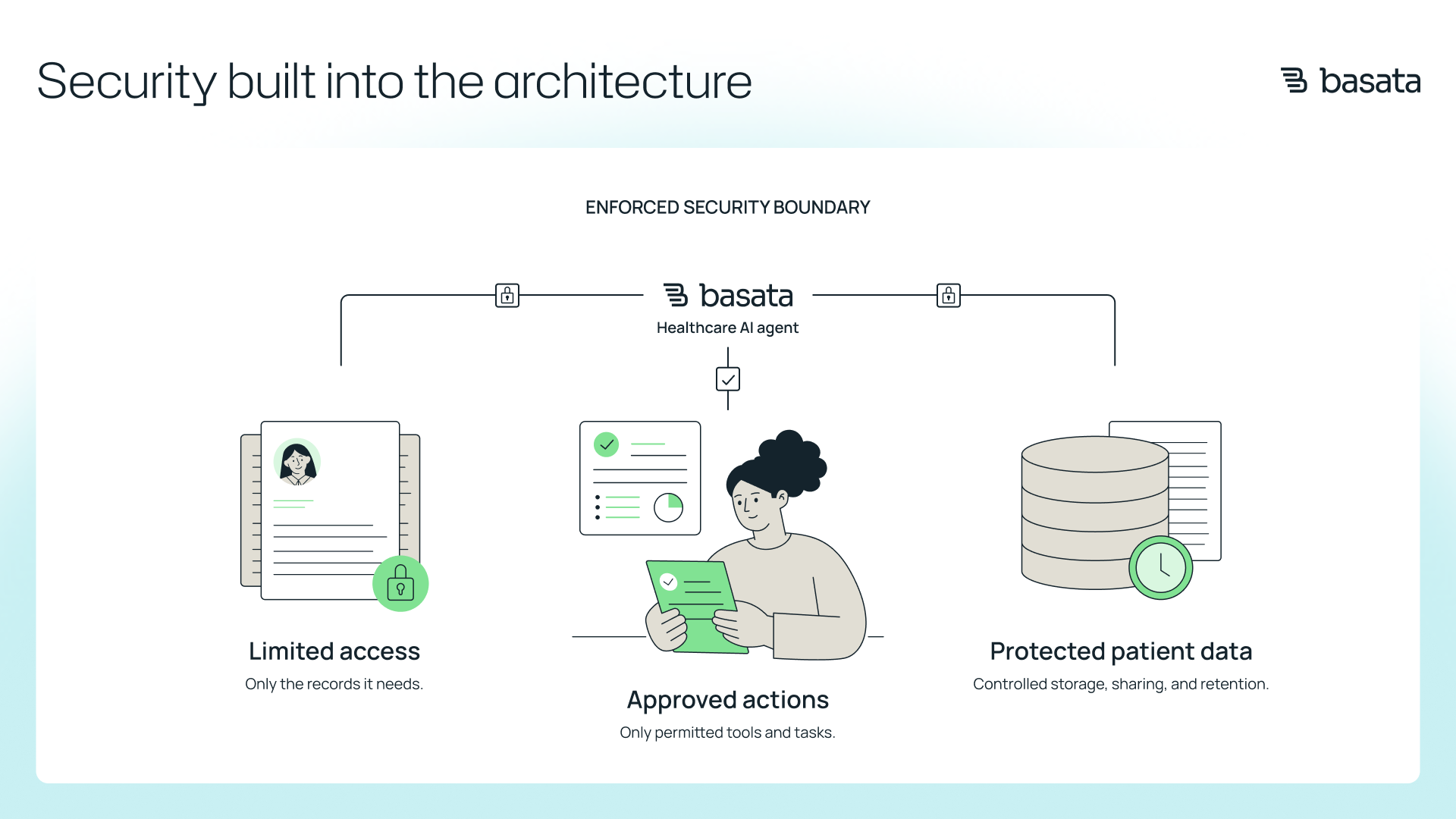
Security must be part of the architecture
Healthcare organizations should not have to choose between using AI to increase capacity and maintaining control over sensitive workflows.
Basata builds purpose-built healthcare AI agents around defined responsibilities and technical boundaries:
- Scoped roles: Each agent is configured for a specific healthcare workflow and receives access only to the patient information, systems and tools required for that task.
- Workflow-native integrations: Agents work through defined integrations with existing EHR/EMR, fax and patient call-center systems.
- Comprehensive audit trails: Document and patient call histories show what an agent received, extracted, routed and changed.
- No model training on patient data: PHI is used to complete authorized workflows, not to train or improve shared AI models.
Secure healthcare AI starts with clearly defined responsibilities, limited access to sensitive data, technical controls over what agents can do, and full visibility into their actions. Together, these safeguards give healthcare organizations the confidence to deploy AI across increasingly complex workflows.
That is how healthcare organizations can put AI to work while remaining in control.
Healthcare AI security: Frequently asked questions
How do healthcare AI agents protect patient data?
Secure healthcare AI agents use controls such as restricted access to PHI, defined roles and permissions, encrypted data handling, controlled system integrations and auditable activity logs. These measures help organizations limit unnecessary access to sensitive information and maintain oversight of automated workflows.
What is the difference between traditional healthcare cybersecurity and AI agent security?
Traditional healthcare cybersecurity focuses on protecting systems, networks, and patient data from unauthorized access and misuse. AI agent security adds another layer of protection by controlling what autonomous agents can access, decide, and do. This includes restricting agent permissions, enforcing technical boundaries, recording actions, and continuously testing agent behavior as models and workflows change.
What security controls should healthcare organizations require from AI vendors?
Healthcare organizations should evaluate baseline security practices, HIPAA-related safeguards, contractual protections, access controls, auditability, data retention, human oversight and ongoing agent testing. Vendors should be able to demonstrate how these controls are implemented within actual healthcare workflows, rather than relying solely on general security policies.
Can healthcare AI agents securely access electronic health records?
Yes. AI agents can interact with EHRs through controlled integrations and approved APIs that limit the information they access and the actions they perform. Appropriate permissions, audit trails and human review requirements can help healthcare organizations automate administrative work while maintaining control over clinical records.
How can healthcare organizations safely automate patient access and scheduling with AI?
Healthcare organizations can reduce risks when automating patient access and scheduling by using AI agents with defined roles, restricted permissions, controlled EHR integrations, and appropriate human oversight. These safeguards help ensure agents can perform authorized tasks, such as managing referrals and scheduling appointments, without unrestricted access to sensitive patient information or clinical systems.
See how Basata helps healthcare organizations increase capacity while maintaining oversight of critical workflows.
See related articles






Ready for your administrative breakthrough?
Get in touch today and learn how Basata can give your admin team superpowers.