Case Study
How N.E.O. Urology Associates Increased Staff Capacity by 4X with Basata
N.E.O. Urology Associates is an independent urology practice serving northeast Ohio and western Pennsylvania, managing genitourinary conditions from diagnosis through surgery and long-term follow-up. As regional pioneers of daVinci robot-assisted surgery and MRI fusion prostate biopsy, N.E.O. Urology pairs minimally invasive treatment with in-office procedures and no facility fees, delivering institution-level capability at community scale.
“Basata stepped directly into our workflow to capture structured, detailed patient requests, helping our team act on them immediately. That shift has cut our overtime costs and provided clarity on overall staffing needs, so we can take on more patients without sacrificing quality.”
Call Volume Outpaced Internal Capacity and Slowed Response Times
As N.E.O. Urology Associates expanded its clinical capabilities and breadth of care, that came with more patient questions, follow-ups, and appointments to coordinate. To maintain timely access to care, Amelia Hanna, Clinical Manager and Registered Nurse, understood that the way N.E.O. managed these patient communications needed to evolve.
Every day, the practice’s nurses and front-office staff received between 400 and 700 calls from patients, nursing homes, and referring hospitals. They had to interpret the request, document it in the appropriate patient record, and route it to a specific nurse or provider. This multi-person process introduced handoffs at every stage, delaying responses to patient requests.
During busy clinic hours, when staff were rooming patients and supporting providers, messages would pile up. The backlog could stretch beyond a week, often requiring costly overtime to catch up and impacting the patient experience.
“Some people are calling in acute discomfort, while others are in cancer care waiting on results,” shares Amelia. “Not being able to contact someone quickly adds stress and uncertainty to an already difficult situation.”
Beyond incoming calls, staff also needed to conduct time-sensitive outreach, such as following up after ER visits and relaying clinical results. And because these callbacks or follow-ups often got delayed, patients would call again, adding duplicate messages to an already crowded queue. Some began calling after 4:30 p.m. to reach the on-call physician, turning routine requests into clinical interruptions and adding another channel to monitor.
Amelia estimated that managing the existing call volume would have required more than 20 new hires. That’s when she began exploring solutions that would fundamentally overhaul the practice’s communication processes. Specifically, she prioritized tools that could deliver immediate improvements while supporting the practice’s long-term needs.
That’s when two physicians on her team discovered Basata. The platform’s purpose-built AI agents made it the ideal solution for streamlining patient communications and ensuring timely access to care.
“We had to go through a 10-step process just to get a message to the nurse who could address it. We didn’t have the time to manage all incoming calls and make time-sensitive follow-ups with the number of physical staff on-site. We needed a dedicated solution. That’s where Basata came in.”
A Configurable AI Voice Agent That Handles Patient Calls End-to-End
Onboarding began by mapping how N.E.O. Urology’s nurses and front-office staff responded to patient calls. The Basata team then configured an AI agent around those specific needs and set up biweekly meetings to gather and implement feedback.
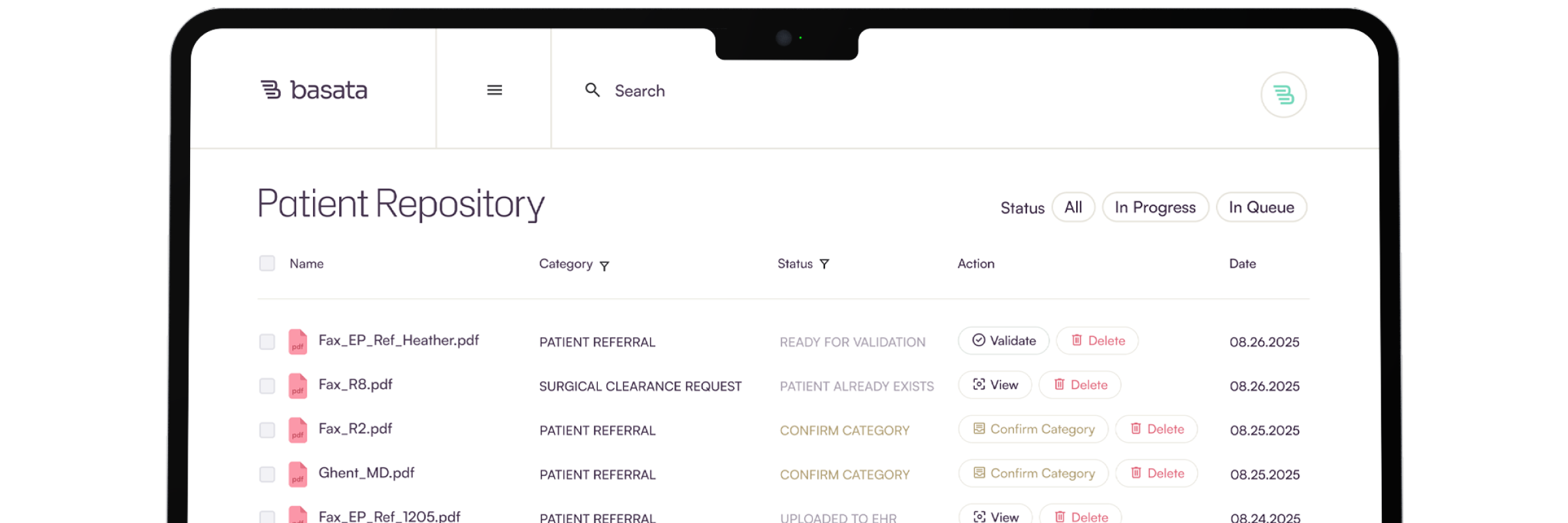
That AI voice agent now serves as the first point of contact for all inbound patient requests. When a patient calls, it listens to their needs, confirms demographic and insurance information, and moves them forward in the process. The immediate response helps set clear patient expectations, reducing repeat calls and strengthening trust in the practice.
After each conversation, Basata generates a structured message that includes the patient’s information and concerns, then routes it directly to the correct nurse or provider. With this level of organization, Amelia and her team no longer have days worth of messages to work through. Instead, they respond within hours, avoiding costly overtime and freeing capacity to assist patients on-site, support providers, and coordinate pre- or post-procedure care.
Patients feel the difference, too. “Patients are so impressed when we call them within an hour,” Amelia says. “They have a stronger connection to their healthcare provider that way.”
With call volume no longer consuming capacity, Amelia has greater clarity into staffing needs, future operational planning, and resource allocation. For example, she now invests time in cross-training staff for other functions, building a more versatile team that can support N.E.O.’s growing practice.
And the ongoing partnership ensures these wins will continue to compound. Basata runs routine planning sessions and maintains consistent team communication to refine the AI agent as the work evolves. As Amelia shares, Basata has come to feel like a part of the team.
“Basata enables our team to process phone calls far more efficiently. This shift has elevated our brand and helped our patients have a more direct line to the care they need.”
N.E.O. Urology Sees 4X Staff Capacity Gains With Basata
By partnering with Basata, N.E.O Urology transformed how it manages patient requests. The practice now delivers faster responses and ensures timely access to care, while freeing up resources for patient care and more strategic operational priorities.
- 3,000 patient calls answered every month, each one on the first ring
- 4X increase in staff capacity
- 100% of clinical messages routed to the right nurse or doctor
Amelia sees Basata as a long-term partner for the practice. With an EMR transition ahead, she will lean on the Basata team for advice on EMR selection and to ensure N.E.O. keeps patient communications organized.
“Basata unlocks better care, daily operational ease, and sustainable business growth, making them a true partner. As we face major changes like moving to a new EMR, having them as a pillar of support gives us real confidence in our future.”
See related articles
Basata Raises $21M Series A to Rebuild the $1T Operational Layer of American Healthcare
How Southwest Cardiovascular Associates Increased New Patient Bookings by 18% with Basata
Midwest Cardiovascular Institute and Basata Partner to Modernize Cardiac Care with Voice AI
MedAxiom Announces Industry Partnership With Basata to Streamline Administrative Burden Using AI Agents
Tri-City Cardiology Expands Partnership with Basata, Accelerating Adoption of Applied AI in Healthcare Operations

When Healthcare Gets Personal: The Mission Behind Basata

Understanding HIPAA Compliance for AI in Healthcare

Making AI Actually Useful: How LLMs Get Put to Work

Guide to AI for Medical Practice Administration Leaders
Ready for your administrative breakthrough?
Get in touch today and learn how Basata can give your admin team superpowers.