Success Story
Oct 14, 2026
1% Call Abandonment, Sub-30-Second Holds: How MCI Freed Its Team

Your Team Didn’t Sign Up for Endless Admin. Here’s How One Cardiology Practice Gave Them Their Time Back.
Your phones don’t stop. Patients call, then call again, then call a third time. Hold times stack up. By the time they reach the exam room, the first thing they tell the doctor isn’t about their heart. It’s about how long they waited on the phone.
For Midwest Cardiovascular Institute (MCI), a physician practice in Chicago’s western suburbs, that was daily reality. In a recent MedAxiom HeartTalk episode, CEO Jacob Corbell, sat down with MedAxiom Heart Talk host Melanie Lawson, MS, to talk about where AI is making the biggest difference in cardiology today. His answer: the admin side.
The problem: 1,300 calls a day and not enough hands
MCI handles about 1,000 calls a day, climbing to 1,200 or 1,300 on Mondays and Tuesdays.
“It’s hard in a call center environment to find enough employees that want to do that all day,” Corbell said. “So hold times stack up.”
And when patients can’t get through, the frustration follows them into the clinic. “It creates this bottleneck everywhere,” he said.
Meet Ava: the call center teammate patients love
MCI partnered with Basata and started with voice AI. The practice customized everything, from voice inflection to tone. Then they let their physicians name it. They chose Ava.
Today, Ava answers the phones at MCI and handles tasks like prescription refills: collecting patient information, confirming their pharmacy, and submitting the request.
Patients can’t always tell the difference. “They thought it was a real person and said, ‘Ava was so friendly. She was great,’” Corbell said. Ava earned the highest-scoring post-call survey in the entire practice. One patient even walked into the office asking to meet her.
The results speak for themselves:
- Call abandonment: 1%
- Hold times: under 30 seconds
Why Basata: end-to-end tech and people who show up
Corbell is candid that AI tech alone isn’t a differentiator anymore. “The tech is a bit ubiquitous now,” he said. What set Basata apart was two things.
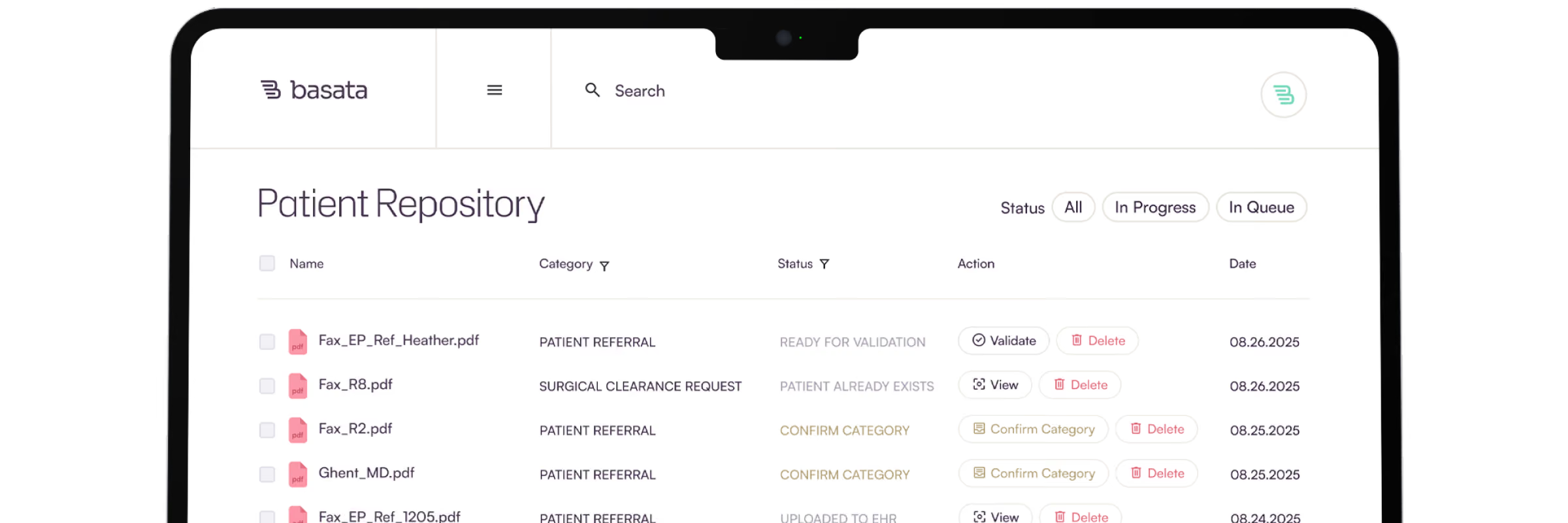
First, it’s end to end. Voice was the starting point, but Basata also handles faxes and a long list of admin workflows. Take referral faxes from primary care: today, staff manually enter those into the chart. Basata automates it.
“We started with voice, but we will use Basata for literally everything,” Corbell said.
Second, the team. “They came on site and spent several days in the trenches with our team designing the workflow,” he said. “You just don’t see a lot of companies willing to roll up their sleeves.”
Basata didn’t treat MCI as another flag on the map. “It was, ‘How do we solve your problem?’” Corbell said. “If they didn’t do that, I wouldn’t be here.”
The real win: freeing your people, not replacing them
Here’s the part every practice leader should hear. MCI isn’t using AI to cut staff. It’s using AI to redeploy them.
“We don’t think AI is going to replace people in healthcare,” Corbell said, quoting advice he’d heard. “We think people that use AI are going to replace the people that don’t use AI.”
The staff once buried in faxes now help with phones and the front office. And Corbell sees the same opportunity for clinical teams stuck fighting prior authorizations.
“They didn’t go to training for that,” he said. “They want to take care of patients. If we can give that to AI, they can spend more time actually taking care of patients.”
What’s next: AI that keeps independent practices independent
Demand for cardiology is outpacing supply, and the gap is growing. Ten thousand people turn Medicare age every day.
“How do you take a cardiologist’s expertise and expand it?” Corbell asked. “It’s technology. It’s virtual care. It’s AI.”
MCI knows this firsthand. The practice moved a large group of physicians out of hospital employment and into private practice. Corbell says plenty of doctors want that same control over how they deliver care, but the administrative load keeps them from making the leap.
That load is where costs really add up. It’s not rent or payroll, Corbell explained. It’s the regulatory requirements and payer demands piled on top. Prior authorizations. Scheduling. Tasks that don’t need a clinical or even clerical person.
“Solve those so we can be free to actually take care of the healing part,” he said.
His bottom line: any group in medicine today “has to be equipped with those solutions.”
See related articles











Ready for your administrative breakthrough?
Get in touch today and learn how Basata can give your admin team superpowers.